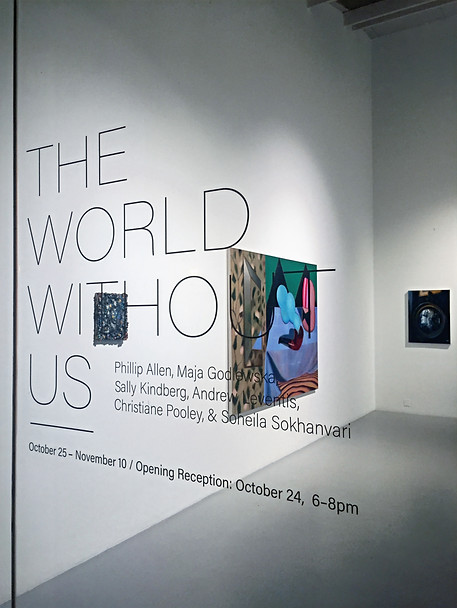
THE WORLD WITHOUT US
Phillip Allen, Maja Godlewska, Sally Kindberg, Andrew Leventis,
Christiane Pooley and Soheila Sokhanvari
25 October–10 November 2019
APT Gallery
Harold Wharf, 6 Creekside, Deptford SE8 4SA
Private View: Thursday, 24 October, 6–8 pm
Few things are more commanding than our own image – after all, the wealthy and the influential have demonstrated the power of an iconic portrait century after century. But what of the digital era and its effect on the painter and, in particular, our image of self? In the past, the aristocrat or the ruler might assert their dominance through a commissioned portrait, surrounded by carefully staged possessions and symbols. Today, the contemporary cultivation of glamour is instantaneously related through the filters of Instagram as electronic devices carve new divisions for potential class categories. The sublime now becomes the backdrop of the selfie, and easy access to quick image making means that essentially everyone can mimic what the traditional painter constructed slowly and deliberately through physical material. How do painters respond to this? What is the role of the painter in this era? Do painters still maintain a separate and special perspective to examine culture in such circumstances? The infiltration of the digital is unavoidable and The World Without Us pays homage to this. Running from 25 October–10 November 2019 at APT Gallery, London, it examines these issues through the works of six contemporary painters: Phillip Allen, Maja Godlewska, Sally Kindberg, Andrew Leventis, Christiane Pooley and Soheila Sokhanvari.
Each artist shares an interest in how reality is fabricated across media, whether exemplified in the exoticised paintings of Tiepolo, or in the sterilised and diagrammatic environments of Jacques Tati. They borrow imagery that is already a reiteration of reality, drawing on everything from telephone cameras and snapshots from film and television to family photo archives, and even clickbait advertisements. The resulting works reconfigure contemporary mass media into painting as reimaginings of their instantaneous counterparts.
“The theme is topical, and perhaps more urgent than ever for painting, as more of painting is created digitally through tablets, Instagram filters, iPhones, etc,” says Leventis. “How does traditional painting respond to – or have a dialectical relationship with – these technologies? How do these technologies change the content, style, and feel of traditional painting? How would Luc Tuyman's paintings look, for example, if he didn't use CCTV and low-grade video and photo references?” The resulting works on display in The World Without Us show each painter’s unique relationship to new media. For Andrew Leventis, this translates to painstakingly painted still lifes of chandeliers, table tops, and convex mirrors reminiscent of Van Eyck’s Arnolfini Portrait.
Similarly, Sally Kindberg’s paintings of everyday objects take on a two-dimensional quality – a glass of wine at once flatted into a single image plane, both photographic and yet not so. Maja Godlewska, meanwhile, has been researching “the spectacle of global Insta-tourism in search of the Sublime landscape.” In doing so, she tracks travellers in the most Instagrammable locations. “I am interested in the ‘tourist gaze’,” she explains, or “’selfie-gaze-tourism’, the colonising aspect of excessive photography, in the notions of being and experiencing and what may unfold and be ignored outside of our perpetually employed viewfinders.” The resulting work unfolds on long paper scrolls, with Godlewska working from memory, “attempting to revisit places once seen and recreate an experience… ironically, my paper installations serve as good selfie backdrops as well.” There are more abstract approaches too – such as Phillip Allen’s sea anemone-like sculptural paintings, swirling with references like the currents on the sea floor. Or Christiane Pooley, who deftly combines abstract painterly strokes with figurative portraits, creating scenes that are at once dream-like and yet infinitely real. Soheila Sokhanvari re-examines historical reality – specifically taking pre-revolutionary Iran as her starting point, weaving layers of political histories with bizarre, humorous and mysterious narratives that are then left to viewer’s own sensitivity to complete. “These images done in the traditional technique of egg tempera on calf vellum become the skeleton for the narrative which is imbued with symbolism, metaphor and magic realism,” she explains.
APT Gallery
APT is a registered charity committed to promoting the value of creativity through the visual arts. Located in South East London, A.P.T supports an exceptional resource and facility for artists and the wider community. With the provision of secure studios and high quality exhibition space as a cornerstone, A.P.T aims to foster an environment where creativity may flourish, forging links and collaborations with other professional bodies both locally, nationally and internationally.